
Enterprise cloud strategy has shifted dramatically over the past year, no longer confined to "lift and shift" migrations or chasing cost savings.
Today, cloud decisions are inseparable from AI ambitions, security demands, and business agility goals.
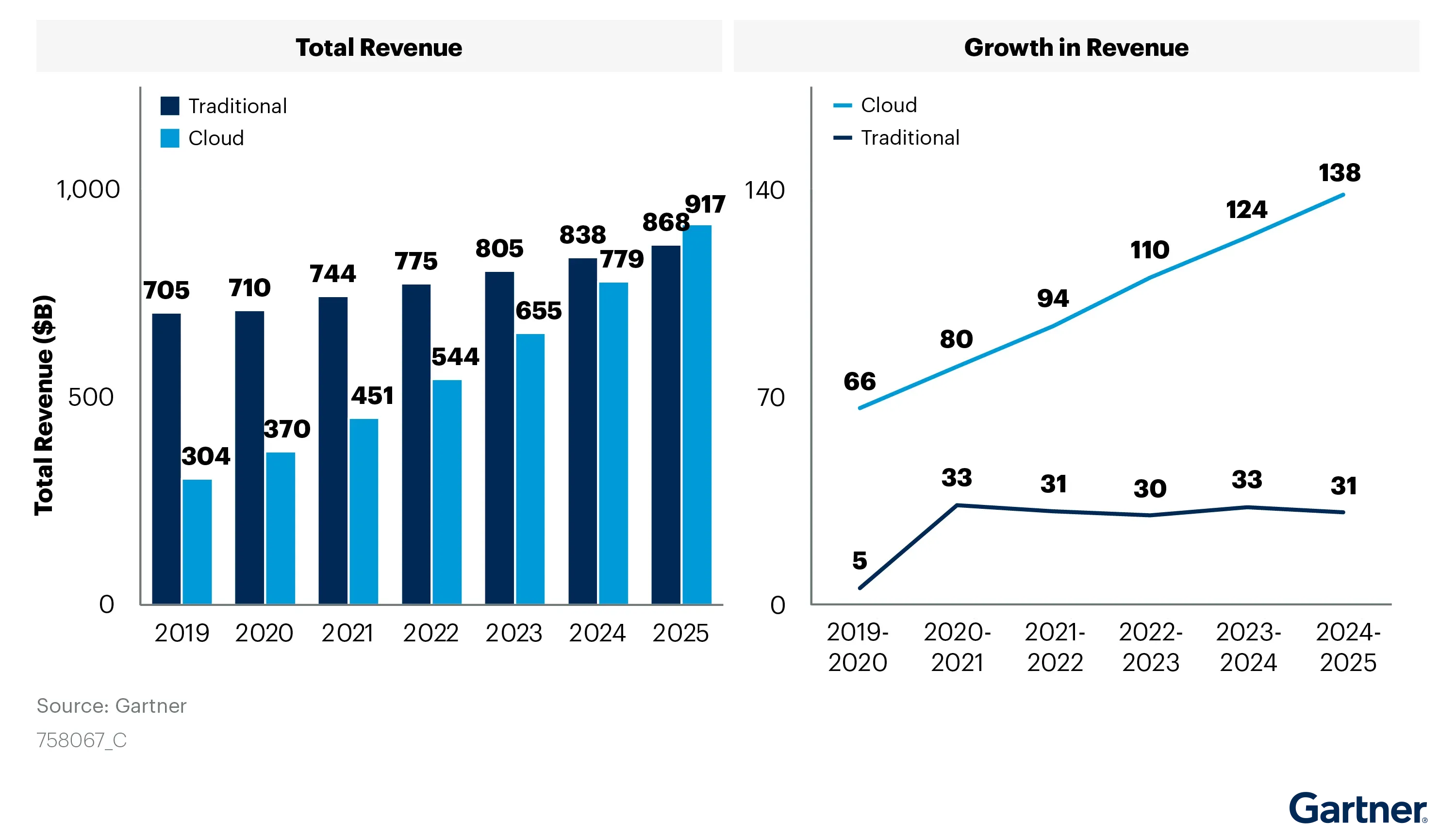
Global spending on public cloud services is expected to reach $723.4 billion and it's not just about scale anymore, but about smarter, more intentional use.
Here are seven cloud strategy trends shaking up enterprise IT this year — and what they mean for leaders driving digital transformation:

1. Hybrid Clouds are the New Normal
Cloud architecture is being reengineered around AI performance. Enterprises are blending public, private, and edge infrastructure to reduce latency, improve data sovereignty, and manage costs — all while supporting increasingly complex AI workloads.
“AI isn’t just on the cloud — it’s now shaping the cloud,” says Robert Kim, CTO at Presidio.
This marks a turning point. The new standard is not "cloud-first" but "AI-ready hybrid cloud," with compute moving closer to data sources.
Organizations prioritizing sovereignty, sustainability, and speed will be at the forefront of the next wave of digital innovation.
2. Industry-Specific Clouds = Focused Strategies
Vertical cloud platforms — tailored for sectors like healthcare, finance, and manufacturing — are surging in adoption.
They combine infrastructure, domain-specific AI models, and pre-built compliance tools to deliver faster results.
“These clouds align with real business needs,” says Chandrakanth Puligundla of Albertsons. “They’re not just technical tools — they’re strategic accelerators.”
However, CIOs must tread carefully. Vertical platforms offer speed but may bring vendor lock-in and skill gaps. The real win lies in balancing agility with extensibility.
3. Replacing On-Prem Legacies
Modern ERP migrations aren’t just IT upgrades — they’re organizational overhauls.
The move to cloud-based ERP is especially active in education and healthcare, where legacy systems often lag behind current business needs.
“It’s a cultural reset,” says Taran Lent, CTO at Transact+CBORD. “Cloud ERP forces institutions to rethink processes they haven’t touched in decades.”
These platforms are increasingly tailored by sector and powered by AI, offering more intuitive, scalable, and student/patient-centered interfaces.
This is less about technology and more about freeing talent for more strategic work.
4. AI/ML Dominate Cloud Infrastructure
The explosion of AI workloads is transforming cloud strategy.
By 2029, Gartner expects AI/ML to consume 50% of cloud compute resources — a massive leap from less than 10% today.
“The convergence of cloud and AI is a business transformation, not just a tech one,” says Ryan Searles, VP at TransUnion.
CIOs who align their cloud investments with AI scalability, performance, and integration will gain a competitive edge — especially as generative AI becomes embedded in every core function.
5. Cloud Strategy Centers on Business Efficiency
The cloud isn’t always the cheapest or most efficient option — and leaders are recognizing that.
More organizations are taking a hybrid approach, optimizing workload placement across environments based on business priorities.
“Hybrid architectures are more complex,” says Tanuj Raja of TD SYNNEX, “but when done right, they unlock greater efficiency, security, and control.”
This shift demands careful workload analysis, governance frameworks, and real-time visibility into costs and performance.
6. Security deepens into Cloud Stacks
Security is no longer bolted on — it’s baked in from the start.
With AI threats like model poisoning and synthetic phishing on the rise, security must evolve into an always-on, proactive posture.
“Secure-by-design is becoming the gold standard,” says Brandon Bowers of Berkowitz Pollack Brant.
This approach integrates protection into every architectural layer — from design to deployment — ensuring resilience by default.
Expect more organizations to automate threat detection, apply AI-driven monitoring, and align tightly with regulatory frameworks.
Final Thought
Cloud strategy is an evolving, multi-dimensional game — one that balances AI, security, industry context, and business outcomes. In 2025, successful CIOs will be the ones who treat cloud as a strategic enabler, not just a tech platform.
The winners? Those who think beyond infrastructure and lead with vision, speed, and cloud-smart discipline.